
How to Build a Shari’ah-Compliant Investment Portfolio in South Africa
A Shari’ah-compliant investment portfolio holds assets screened to meet Islamic law: no interest-bearing instruments, no businesses with prohibited activities, and no contracts involving excessive uncertainty or speculation. If you’re building one in South Africa, you have more options than most people realise. Shari’ah-compliant unit trusts, tax-advantaged retirement annuities, offshore feeder funds, and Islamic bank accounts are all available from established providers. The framework for constructing this portfolio isn’t fundamentally different from conventional portfolio construction. You still decide on asset allocation, investment structure, offshore exposure, and your income drawdown in retirement. The difference lies in which specific assets and products you use within each decision.
A quick note on terminology: many readers use “halal” and “Shari’ah-compliant” interchangeably when searching. Both refer to the same standard. “Shari’ah-compliant” is the precise term used by the South African financial industry, regulators, and asset managers, so I’ll use it throughout.
For a broader view of how these investments fit into your overall financial plan, see Shari’ah-compliant financial planning in South Africa.
What Makes an Investment Shari’ah-Compliant?

An investment is Shari’ah-compliant when it avoids three core prohibitions: riba (interest or usury), gharar (excessive uncertainty in a contract), and maysir (gambling or pure speculation). Beyond those, it must exclude businesses whose primary activity is in alcohol, conventional banking and insurance, tobacco, pork, weapons, and adult entertainment.
Understanding these prohibitions matters because they shape every asset class decision you’ll make.
Riba means any pre-determined, fixed return on a loan or deposit is prohibited. This rules out conventional bonds, fixed deposits, and money market funds that earn interest. That’s why a Shari’ah-compliant cash fund uses profit-sharing or commodity murabaha structures rather than a standard call account.
Gharar refers to contracts where the outcome is excessively uncertain or where the terms are unclear to one party. This is why conventional derivatives and certain structured products are generally not used in a Shari’ah portfolio.
Maysir is the prohibition on gambling and speculation. This doesn’t mean Shari’ah portfolios avoid risk altogether; all investment involves risk. It means that contracts where one party’s gain is purely another party’s loss, with no underlying economic activity, are excluded.
One common misconception: ESG (environmental, social and governance) funds and ethical funds are not the same as Shari’ah-compliant funds. There’s sometimes overlap (both may exclude tobacco or weapons), but an ESG fund will typically hold conventional bonds and interest-paying instruments. Unless a fund is explicitly certified as Shari’ah-compliant by a qualified Shari’ah supervisory board, it doesn’t meet the standard.
Finally, there’s the concept of purification. Because some compliant companies may earn a small incidental amount of interest income from a bank account, a portion of the dividend or return is calculated and donated to charity. This is a routine, well-established practice in Islamic finance, not a sign that a fund is impure. Most Shari’ah-compliant unit trust managers handle the calculation for you and report it annually.
For a specific example of how this works with larger capital, see how to invest R5 million according to Shari’ah principles.
The Building Blocks of a Shari’ah-Compliant Portfolio
A Shari’ah-compliant portfolio can hold a full range of asset classes: equities, sukuk (Islamic bonds), real estate investment trusts screened for compliance, cash equivalents using profit-sharing structures, and offshore assets. The restriction is on the specific instruments within each class, not on the class itself.
Here’s how each building block works in a South African context.
Equities
You can invest in shares listed on the Johannesburg Stock Exchange (JSE) provided those companies pass a Shari’ah screen. The screen looks at business activity first (sector exclusions) and then at financial ratios, checking that the company’s debt relative to its assets stays within defined limits. Several South African asset managers maintain their own screening methodology, certified by a Shari’ah supervisory board. The number of JSE-listed shares that pass the screen changes over time as company financials move, so no fixed count is reliable; your fund manager’s board reviews the list regularly.
Sukuk and Fixed-Income Alternatives
Conventional bonds pay interest, which is prohibited. Sukuk are Islamic finance instruments that represent ownership in an underlying asset or project and pay a share of profit rather than interest. In South Africa, the sukuk market is smaller than the conventional bond market, which means a Shari’ah-compliant fixed-income allocation tends to draw on offshore sukuk (accessed through feeder funds) and domestic profit-sharing instruments.
Cash and Liquidity
For cash holdings, some South African banks offer Shari’ah-compliant savings accounts and call accounts. HBZ Bank is one of the dedicated Islamic banking institutions operating in South Africa. The major retail banks also offer Islamic banking windows, including Absa Islamic Banking and FNB Islamic Banking, which structure deposits on a mudarabah (profit-sharing) or wadiah (safekeeping) basis rather than paying interest.
Real Assets and Listed Property
Certain listed property funds can be held in a Shari’ah portfolio if they pass a compliance screen. The underlying properties must not be predominantly leased to non-compliant tenants (such as alcohol retailers or casinos), and the fund’s financing must keep conventional debt within acceptable limits.
Unit Trusts and ETFs
For most investors, the practical way to access these asset classes is through Shari’ah-compliant unit trusts and exchange-traded funds. These pool the screening, the purification, and the ongoing monitoring into a single product. See how unit trusts work in South Africa and exchange traded funds in South Africa for how these structures work before selecting funds.
Which Unit Trusts and Banking Products Are Shari’ah-Compliant in South Africa?
Several established South African asset managers offer Shari’ah-compliant unit trusts, and the major banks provide compliant savings and transactional products. The range is substantial enough to build a properly diversified portfolio without leaving the compliant universe.
Shari’ah-Compliant Unit Trusts
The asset managers with documented Shari’ah-compliant unit trust ranges in South Africa include:
- Allan Gray offers a Shari’ah-compliant share fund and a money market fund structured to avoid interest.
- Oasis Crescent, one of the longest-established dedicated Islamic asset managers in South Africa, maintains a range spanning equity, balanced, and income funds.
- Stanlib and Sanlam both have Islamic fund ranges available through their platforms.
- Satrix offers a Shari’ah-screened equity ETF tracking JSE-listed shares that pass the compliance screen.
You should verify the current fund range directly with the asset manager or a qualified financial planner, because product ranges change. Don’t rely on an article (including this one) as a definitive list.
No performance figures or star ratings appear here, because those change constantly. A number that was accurate when written can mislead you when you read it.
How Unit Trust Investments Work
A unit trust pools money from multiple investors and invests according to a stated mandate. When you invest, you buy units at the current price. The value of your units moves with the value of the underlying assets. For a Shari’ah-compliant unit trust, the mandate explicitly limits investments to assets that pass the screening process, and a Shari’ah supervisory board audits the fund’s holdings. See Shari’ah-compliant financial planning for how these funds fit into a broader plan.
Banking and Savings Products
For transactional banking and savings, Absa Islamic Banking, FNB Islamic Banking, and HBZ Bank all offer current accounts, savings accounts, and fixed-term investment products structured on Islamic principles. Profits are shared rather than interest paid, and the account terms are certified by a Shari’ah board. For retirement-specific products from a major provider, see also Allan Gray retirement annuity as an example of how a large asset manager integrates Shari’ah-compliant fund options into a retirement annuity wrapper.
How Retirement Accounts Fit Into a Shari’ah-Compliant Portfolio
Retirement accounts are not inherently compliant or non-compliant. What matters is which underlying funds you select within the account wrapper. A retirement annuity, preservation fund, or living annuity can be fully Shari’ah-compliant, provided the underlying funds pass the screening requirements.
Here’s how each structure works and what to consider.
Retirement Annuity (RA)
A retirement annuity is a tax-advantaged product for saving towards retirement outside an employer fund. Contributions are tax-deductible up to prescribed limits. Inside the RA, you choose the underlying funds. If the funds you select are Shari’ah-compliant, the RA itself is operated on compliant principles. The RA is subject to Regulation 28, the rule that limits how much of a retirement fund can sit in each asset class (a maximum of 45% in equities and a maximum of 45% offshore, for example) to keep retirement savings diversified. These limits apply regardless of whether the funds are conventional or Shari’ah-compliant, and your Shari’ah-compliant fund selection must fit within them.
Preservation Fund
A preservation fund holds retirement savings when you leave an employer before retirement, keeping them in a tax-efficient structure. Like the RA, it’s Regulation 28-governed and the compliance of the portfolio depends on the funds you hold inside it. See how a preservation fund works in South Africa for a full explanation of the rules.
The Two-Pot System
Under the two-pot retirement system, your retirement fund savings are split into a savings component (accessible once per tax year) and a retirement component (preserved until retirement). When selecting funds in either component, the Shari’ah-compliant options available to you depend on what your fund or RA provider offers. If your current provider has limited compliant fund options, that’s a legitimate reason to consider transferring to a provider with a broader Shari’ah-compliant range. For a comparison of fund structures, see retirement annuity vs provident fund.
Living Annuity at Retirement
A living annuity is a retirement income product where you remain invested after retirement and draw an income you choose within set limits (currently between 2.5% and 17.5% of the fund value per year). The remaining balance can pass to your beneficiaries. A living annuity can be structured on Shari’ah principles by selecting compliant underlying funds, just as you would in an RA. The critical planning question is the drawdown rate: how much you withdraw each year relative to the growth your portfolio generates. A portfolio drawing at 5% per year from an equity-heavy Shari’ah fund has a materially different sustainability outlook than one drawing at 10%. Keeping your drawdown rate sustainable is as important in a halal portfolio as in any other. See income choices for South African retirees for a fuller treatment of this decision.
How to Access Offshore Shari’ah-Compliant Investments from South Africa
South African residents can invest offshore within two main allowances: a R1 million single discretionary allowance per calendar year (no SARS approval needed) and a R10 million foreign capital allowance per year (which requires a SARS tax clearance). These allowances apply to all residents, regardless of whether you’re investing in conventional or Shari’ah-compliant assets.
The most practical route for most investors is the feeder fund. A feeder fund is a South African-registered unit trust that pools rand contributions and invests them into an underlying offshore fund. You invest in rands, the fund manager handles the currency conversion and regulatory compliance, and you access global Shari’ah-compliant markets without needing a foreign brokerage account. Several South African asset managers, including Oasis Crescent, offer offshore or global Shari’ah-compliant feeder funds.
Why Offshore Exposure Matters in a Shari’ah Portfolio
Currency diversification is a portfolio benefit in its own right. Holding assets denominated in US dollars, euros, or British pounds reduces your dependence on the rand and gives your portfolio access to global companies and sectors that may not be represented on the JSE. For a Shari’ah-compliant investor, global markets offer a wider compliant equity universe, including major technology and healthcare companies that pass the Shari’ah screen.
Globally, established Shari’ah-compliant equity indices exist (such as the Dow Jones Islamic Market indices and the MSCI Islamic indices) and a range of sukuk funds that a feeder fund can access on your behalf.
The offshore allocation that makes sense for your portfolio depends on your total asset base, your income needs in retirement (and in which currency those needs are denominated), and your estate planning considerations. Don’t decide on a percentage in isolation from those factors. See offshore investing for South African retirees and investing offshore from South Africa for more detail on the mechanics and the allowances. For the role currency exposure plays in a portfolio, see why currency diversification matters.
Shari’ah-Compliant vs Conventional Portfolio Construction: Key Differences

The structural logic of building a Shari’ah-compliant portfolio is the same as conventional portfolio construction: you decide on an asset allocation, select appropriate vehicles, manage tax efficiency, and monitor the result. The differences are in the instruments available within each asset class and in a few additional compliance steps. Neither approach is inherently superior in performance terms, and the claim that Shari’ah portfolios underperform isn’t supported by the long-run evidence from established managers.
The table below sets out the key differences:
| Dimension | Shari’ah-Compliant Portfolio | Conventional Portfolio |
|---|---|---|
| Equity screening | Required: sector and financial ratio screen | Not required |
| Fixed income | Sukuk and profit-sharing instruments | Conventional bonds and money market |
| Cash | Profit-sharing deposits (mudarabah/wadiah) | Interest-bearing deposits |
| Derivatives | Generally excluded (gharar) | Available |
| ESG overlap | Partial: some sectors excluded, but not the same standard | Separate ESG screen if applied |
| Purification | Annual calculation; small amount donated to charity | Not applicable |
| Supervisory board | Required: independent Shari’ah board audits holdings | Not required |
| Investable universe | Narrower on JSE; broader globally through sukuk and Islamic ETFs | Broader domestically |
| Regulation 28 | Applies equally in retirement funds | Applies equally in retirement funds |
| Offshore access | Available via feeder funds and direct allowances | Available via feeder funds and direct allowances |
The narrower domestic investable universe is a real trade-off. Fewer JSE shares pass the screen, and the sukuk market in South Africa is smaller than the conventional bond market. This is why offshore exposure often plays a more prominent role in a well-structured Shari’ah portfolio than it might in a comparable conventional one.
For thoughts on how this affects concentration risk, see managing risk concentration in a portfolio.
Putting the Portfolio Together: A Practical Framework
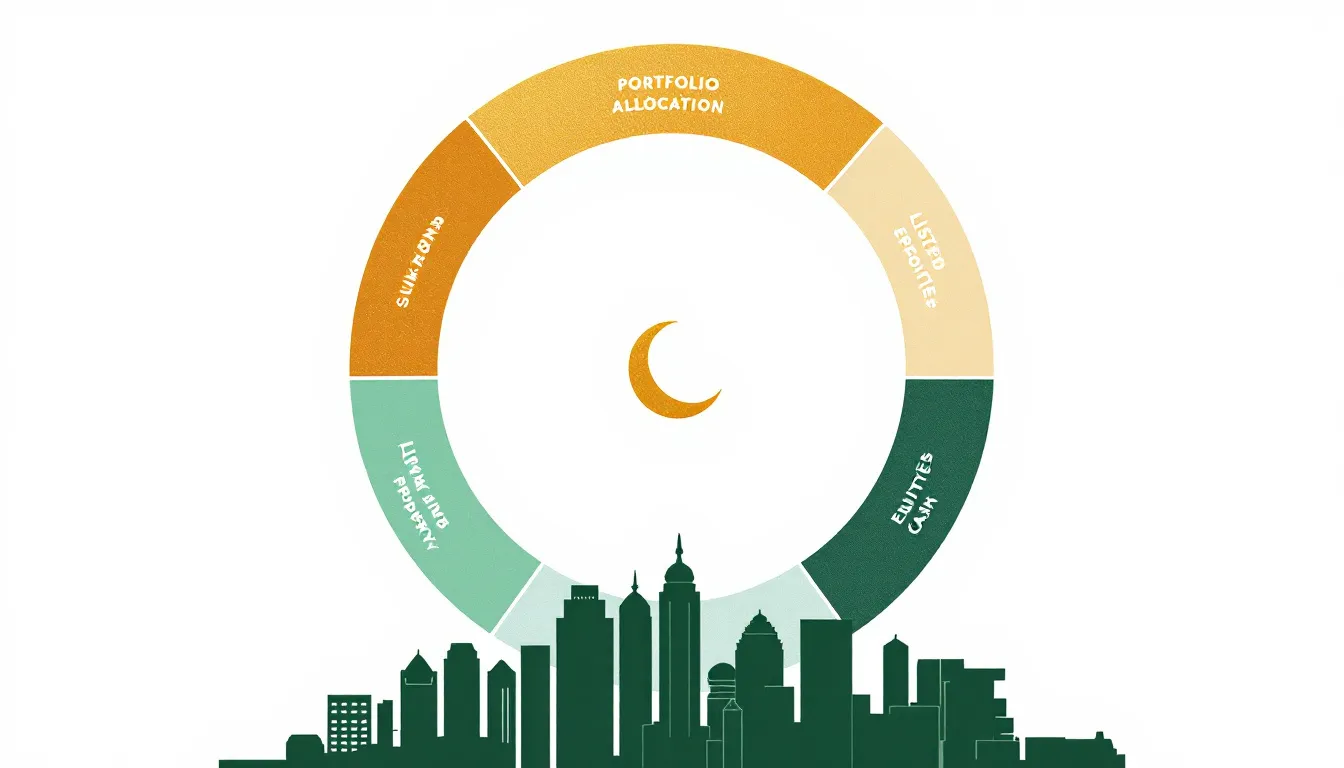
Building a Shari’ah-compliant portfolio follows four steps: decide on your asset allocation, choose the right investment structure for each portion, determine your offshore allocation, and plan your drawdown order. Applying those steps to a specific rand amount makes the decisions concrete.
Take a R10 million portfolio at or near retirement as an example.
Step 1: Asset Allocation
A typical moderate allocation for a retiree drawing income might look like this:
- 55% growth assets (Shari’ah-compliant equities, domestic and offshore)
- 20% income and capital preservation (sukuk, profit-sharing instruments)
- 15% listed property (screened for compliance)
- 10% cash equivalents (Islamic banking call or savings accounts)
On R10 million, that’s R5.5 million in equity funds, R2 million in income instruments, R1.5 million in property funds, and R1 million in cash. Adjust the split based on your income need and your capacity to absorb short-term volatility.
Step 2: Investment Structure
Not all of your R10 million sits in the same wrapper. Some is likely inside a retirement annuity or living annuity (subject to Regulation 28). Some may be in a preservation fund. Some is in your own name. The structure affects both the tax treatment and the Regulation 28 constraints. Inside retirement funds, select from the Shari’ah-compliant fund range your provider offers. Outside retirement funds, you have more flexibility to hold screened ETFs and unit trusts directly.
Step 3: Offshore Allocation
Within a R10 million portfolio, a meaningful offshore allocation (say 25 to 35% of the growth assets) gives you currency diversification and access to a wider compliant equity universe. On R5.5 million of equities, that might mean R1.4 million to R1.9 million in offshore Shari’ah-compliant equities, accessed via feeder funds or directly through your foreign allowance. See investing R5 million on Shari’ah principles for a comparable worked example.
Step 4: Drawdown Order
In retirement, the sequence in which you draw from each pot affects both your tax bill and how long your money lasts. Retirement fund withdrawals are taxed differently from investment account withdrawals. Drawing from your retirement fund first isn’t always the right answer. The optimal drawdown order depends on your total picture: fund values, tax rates, estate considerations, and beneficiary nominations. This is where a holistic plan, covering all your savings at once, makes a real difference. For further guidance on currency-diversified ETF options within the portfolio, see currency diversification ETFs.
Frequently Asked Questions
What investment options are available that comply with Shari’ah principles in South Africa?
Shari’ah-compliant investment options include screened equity unit trusts, balanced funds, income funds using profit-sharing structures, Shari’ah-screened ETFs, Islamic bank savings and deposit accounts, and offshore feeder funds investing in global sukuk and Islamic equities. Providers such as Oasis Crescent, Allan Gray, Satrix, Stanlib, and Sanlam all have documented Shari’ah-compliant ranges. You can also hold Shari’ah-compliant assets inside a retirement annuity, preservation fund, or living annuity.
Which unit trusts in South Africa follow Shari’ah guidelines?
Unit trusts with a certified Shari’ah-compliant mandate include funds from Oasis Crescent, Allan Gray’s Shari’ah-compliant share and money market funds, and Islamic fund ranges from Stanlib and Sanlam. Each fund is audited by an independent Shari’ah supervisory board. Always verify the current fund list directly with the asset manager, as ranges change.
How can someone access offshore investments while based in South Africa?
South African residents can invest offshore using a R1 million annual single discretionary allowance (no SARS approval required) or a R10 million foreign capital allowance (which requires a tax clearance from SARS). The most practical route is a rand-denominated feeder fund that invests into a global Shari’ah-compliant fund, removing the need for a foreign brokerage account. See Shari’ah-compliant financial planning guide for more.
What are the best retirement investment options available in South Africa for Shari’ah-compliant investors?
A retirement annuity with Shari’ah-compliant underlying funds is the most tax-efficient way to save for retirement outside an employer fund. At retirement, a Shari’ah-structured living annuity lets you stay invested in compliant assets and pass the remaining capital to your beneficiaries. The “best” option depends on your age, tax position, income need, and existing fund structures, which is why a holistic plan across all your pots is more useful than a single product recommendation.
Which companies provide Shari’ah-compliant business funding in South Africa?
Business funding is outside the scope of the retirement and investment planning services covered here. For Shari’ah-compliant business finance, including murabaha and ijarah facilities, speak to a specialist Islamic finance provider such as HBZ Bank or the Islamic banking divisions of Absa or FNB, and consult an advisor who specialises in business finance rather than personal investment planning.
What banking and savings products comply with Shari’ah principles?
Absa Islamic Banking, FNB Islamic Banking, and HBZ Bank all offer Shari’ah-compliant current accounts, savings accounts, and fixed-term investment accounts. These products use profit-sharing or safekeeping structures instead of interest. Returns are not guaranteed in the same way as a fixed deposit, because they’re linked to actual profits generated by the bank’s compliant activities.
How do unit trust investments work in South Africa?
A unit trust pools money from multiple investors into a single fund managed according to a stated investment mandate. You buy units at the current price, and those units rise or fall in value as the underlying assets move. For a Shari’ah-compliant unit trust, the mandate restricts the fund to assets that pass a Shari’ah screen, and an independent board audits the holdings. You can invest a lump sum or a regular monthly amount, and you can redeem your units (with some funds allowing same-day or next-day access).
Which investments generate monthly income in South Africa?
For a Shari’ah-compliant investor seeking regular income, a living annuity set to pay monthly draws is the main vehicle in retirement. Outside retirement funds, Shari’ah-compliant income unit trusts and Islamic bank savings accounts distribute profits periodically. Listed property funds that are screened for compliance also distribute income regularly, typically quarterly. None should be confused with a guaranteed fixed monthly payment; the amounts will vary with the fund’s performance and your drawdown rate.
Building a Portfolio That Fits Your Values and Your Financial Goals
A Shari’ah-compliant investment portfolio in South Africa is entirely buildable with the products and providers available today. The four-part framework covers what you need: an asset allocation appropriate for your stage of life, investment structures that use each tax-efficient wrapper correctly, a considered offshore allocation for currency diversification and a wider compliant equity universe, and a drawdown order in retirement that minimises tax and keeps your income sustainable.
The practical challenges are real: the domestic investable universe is narrower than in a conventional portfolio, the sukuk market locally is smaller, and not every provider offers a full Shari’ah-compliant fund range. Those challenges are manageable with good planning. They’re not reasons to default to a conventional portfolio or to accept a Shari’ah-compliant portfolio that is poorly structured.
What matters most is that your portfolio decisions, from which retirement fund to retire from first to how much cash to take at retirement to your drawdown rate in a living annuity, are made with your full picture in view, not one product at a time.
For a broader look at how these decisions connect, read the complete guide to Shari’ah-compliant financial planning. If you’re in the decade approaching retirement or already drawing an income, managing retirement funds in the decade before and after retirement covers the sequencing decisions in detail.
If you’d like to work through your specific portfolio, you’re welcome to visit the Shari’ah-compliant investing page or get in touch directly through the contact page.
This article is general information and not personal financial advice. Your circumstances are specific to you, and a qualified financial planner should review your full picture before you make material changes to your portfolio.